
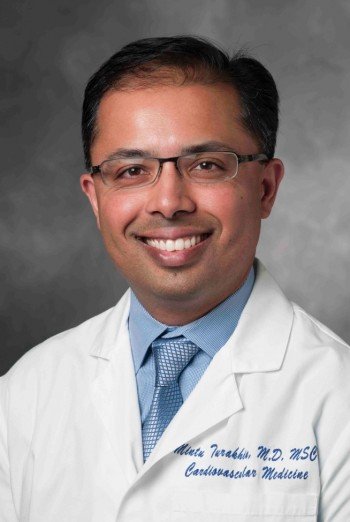
19 Years of Experience
Affiliated with a Castle Connolly Top Hospital
Who is Dr. Turakhia, Clinical Cardiac Electrophysiologist in Stanford, CA?
Where did Dr. Turakhia go to medical school and complete their residency?
Residency: Univ Ca Sf Sch Of Med, Cardiovascular Diseases; Brigham & Women'S Hosp, Internal Medicine
Medical School: University of California
Is Dr. Turakhia board certified as a Clinical Cardiac Electrophysiologist?
Yes, Dr. Minang Turakhia, MD is board certified by the American Board of Internal Medicine
What languages does Dr. Turakhia speak?
Dr. Turakhia and their clinical team can communicate with patients in the following languages:
- English
- French
- Gujarati
- Hindi
- Spanish
- Urdu
What conditions does a Clinical Cardiac Electrophysiologist like Dr. Turakhia typically treat?
As a Clinical Cardiac Electrophysiologist, Dr. Turakhia diagnoses, treats, and manages a wide range of conditions. This condition information is derived from anonymized insurance claims and highlights the medical conditions most commonly treated by Dr. Turakhia. It provides insight into the doctor’s areas of experience and expertise based on real-world patient encounters from the past two years, updated quarterly. Learn more about our claims-based healthcare methodology.
Also known as:
- Other Heart Rhythm Disorder
- Fast Heartbeat
- Atrial Fibrillation
- Slow Heart Rate
- Premature Atrial Contractions
- Supraventricular Tachycardia
- Arrhythmia
- Cardiac Dysrhythmia
- Irregular Heartbeat
- Heart Rhythm Problems
- Tachycardia
- Rapid heart rate
- Racing heart
- Afib
- A-fib
- Irregular heart rhythm
- Bradycardia
- Slow Pulse
- Low Heart Rate
- PACs
- Atrial Ectopic Beats
- Skipped Heartbeat (Atrial)
- SVT
- Fast heart rate
- Rapid heartbeat
ICD-10 Codes:
- I498: Other specified cardiac arrhythmias
- R000: Tachycardia, unspecified
- I4891: Unspecified atrial fibrillation
- R001: Bradycardia, unspecified
- I491: Atrial premature depolarization
- I4710: Supraventricular tachycardia, unspecified
Also known as:
- Abnormal EKG
- Heart Health Tests
- Irregular Electrocardiogram
- Unusual Heart Rhythm Test
- ECG Abnormalities
ICD-10 Codes:
- R9431: Abnormal electrocardiogram [ECG] [EKG]
Also known as:
- Having a Pacemaker
- Pacemakers and Implantable Defibrillators
- Heart pacemaker
- Artificial pacemaker
- Implanted heart device
ICD-10 Codes:
- Z950: Presence of cardiac pacemaker
What procedures does a Clinical Cardiac Electrophysiologist like Dr. Turakhia typically perform?
As a Clinical Cardiac Electrophysiologist, procedures performed by Dr. Minang Turakhia may include:
- Absent Pulmonary Valve Repair
- Anomalous Coronary Artery Angiography
- Anticoagulation Management
- Aortic Stenosis Repair
- Aortic Valve Repair / Replacement
- Aortopulmonary Window Repair
- Arterial Doppler
- Balloon Septostomy
Please contact Dr. Turakhia's office directly to confirm care for your specific procedure, for more information, or to schedule a consultation.
Does Dr. Turakhia accept my insurance?
Dr. Turakhia accepts most major insurance plans. Important: Please call our office at (650) 723-4000 before your appointment to verify that your specific plan and network are accepted.
What insurance plans does Dr. Turakhia accept in Stanford, CA?
Dr. Turakhia in Stanford, CA accepts plans from many carriers. While this list is updated regularly, it is not a guarantee of coverage.
Top Insurances
Advantage
Blue Shield of California
CVS Health (formerly Aetna)
Kaiser Permanente
Medicaid
Medicare
Santa Cruz County
State of California
UnitedHealth Group
Valley Health Plan
View All Insurances
Where is Dr. Turakhia's office located?
What hospitals are Dr. Turakhia affiliated with?

Castle Connolly Top Hospital
This doctor is affiliated with a Castle Connolly Top Hospital.
Dr. Turakhia has admitting privileges at the following hospitals:



Recognitions
Publications
Warfarin treatment in patients with atrial fibrillation and advanced chronic kidney disease
, 2014
Burden, timing, and relationship of cardiovascular hospitalization to mortality among Medicare
, 2013
US Health Care Policy and Reform: implications for cardiac electrophysiology
, 2013
Differences and trends in stroke prevention anticoagulation in primary care vs cardiology specialty
, 2013
Cost-Effectiveness of Dabigatran Compared With Warfarin for Stroke Prevention in Atrial
, 2011
Adherence to dabigatran therapy and longitudil patient outcomes
, 2014
Relation of Left Atrial Dysfunction to Ischemic Stroke in Patients With Corory Heart Disease
, 2014
Association of CHADS2, CHA2DS2-VASc
, 2014
Phenytoin toxicity unlikely to result in arrhythmias-reply.
, 2014
Adherence and persistence in the use of warfarin after hospital discharge among patients with heart
, 2014
Clinical reminders to providers of patients with reduced left ventricular ejection fraction incre
, 2014
Diagnostic utility of a novel leadless arrhythmia monitoring device.
, 2013
Outcomes after kidney transplantation of patients previously diagnosed with atrial fibrillation.
, 2013
Comparative effectiveness of antiarrhythmic drugs on cardiovascular hospitalization
, 2013
Foreword: health policy and cardiac electrophysiology
, 2013
Bizarre and Wide QRS After Liver Transplant.
, 2013
Oral Antithrombotic Agents for the Prevention of Stroke
, 2012
Trends in the Incidence of Atrial Fibrillation in Older Patients Initiating Dialysis
, 2012
Anticoagulation for atrial fibrillation in patients on dialysis: are the benefits worth the risks?
, 2012
Reply: Ability of microvolt T
, 2012
Latency of ECG Displays of Hospital Telemetry Systems A Science Advisory From the American Heart
, 2012
Abrupt bradycardia and grouped beating during treadmill testing: A mimic of upper rate behavior
, 2012
Incidence and clinical predictors of low defibrillation safety margin at time of implantable
, 2012
TRENDS IN THE INCIDENCE OF ATRIAL FIBRILLATION IN OLDER PATIENTS INITIATING DIALYSIS
, 2012
The prognostic value of early repolarization with ST-segment elevation in African Americans
, 2012
AMIODARONE USE IS NOT ASSOCIATED WITH MORTALITY IN PATIENTS WITH ATRIAL FIBRILLATION AND KIDNEY
, 2012
CARDIOVASCULAR HOSPITALIZATION IS A STRONG PREDICTOR OF MORTALITY IN MEDICARE BENEFICIARIES WITH
, 2012
INTERACTION AMONG DIGOXIN USE, KIDNEY FUNCTION
, 2012
Ability of microvolt T-wave alterns to modify risk assessment of ventricular tachyarrhythmic events
, 2012
Left Atrial Function Predicts Heart Failure Hospitalization
, 2012
Cost-effectiveness of pharmacologic
, 2012
Clinical Reminders to Providers of Patients with Depressed Left Ventricular Ejection Fraction
Early Repolarization in an Ambulatory Clinical Population
, 2011
JICE goes social
, 2011
The CHADS(2) score predicts ischemic stroke in the absence of atrial fibrillation among subjects
, 2011
Dabigatran Compared With Warfarin for Stroke Prevention in Atrial Fibrillation
, 2011
Quality of Stroke Prevention Care in Atrial Fibrillation Many Moving Targets
, 2011
Sudden Cardiac Death and Implantable Cardioverter-Defibrillators
, 2010
Using Restriction to Minimize Bias in Observatiol Studies
, 2010
Developing the Safety of Atrial Fibrillation Ablation Registry Initiative
, 2010
Prevalence of Metabolic Syndrome in South Asians Residing in the United States
, 2010
Ippropriate pacing in a patient with maged ventricular pacing: What is the cause?
, 2010
Predicting Heart Failure Hospitalization and Mortality by Quantitative Echocardiography
, 2010
Atrial Mechanical Function Using Left Atrial Pressure Waveform Alysis in Persistent
, 2009
Increase in end-systolic volume after exercise independently predicts mortality in patients with
, 2009
Low ejection fraction prophylaxis with implantable defibrillators in the elderly
, 2009
Polymorphic Ventricular Tachycardia?
, 2009
Rates and severity of perforation from implantable cardioverter-defibrillator leads: A 4-year study
, 2009
Wolff-Parkinson-White syndrome: where is the pathway?
, 2009
Impact of Remote Magnetic Catheter vigation on Ablation Fluoroscopy and Procedure Time
, 2008
Prognostic Significance of Increased Left Ventricular Mass Index to Mortality
, 2008
Impact of advanced age on survival in patients with implantable cardioverter defibrillators
, 2008
The Irritable Heart
, 2008
Knowledge and attitudes of primary care physicians in the magement of patients at risk for
, 2008
Sudden cardiac death: Epidemiology, mechanisms, and therapy
, 2007
Impact of rel function on survival in patients with implantable cardioverter-defibrillators
, 2007
Association of platelet count with residual thrombus in the myocardial infarct
, 2004
Sequential risk stratification using TIMI risk score
, 2004
Association of the Fibocci Cascade with the distribution of corory artery lesions responsible
, 2003
Meperidine and alfentanil do not reduce the gain or maximum intensity of shivering
, 1998
Isoflurane alters shivering patterns and reduces maximum shivering intensity
, 1998
Epidural anesthesia reduces and gain and maximum intensity of shivering
, 1998
Postanesthetic vasoconstriction slows peripheral-to-core transfer of cutaneous heat
, 1997
Rapid core-to-peripheral tissue heat transfer during cutaneous cooling
, 1996
What is Dr. Turakhia's NPI number?A National Provider Identifier (NPI) is a unique ID number that identifies doctors and healthcare providers nationwide.
Dr. Turakhia's National Provider Identifier (NPI) number is 1528114204.
What common questions do patients ask about Dr. Turakhia?
Here are answers to patients Frequently Asked Questions (FAQ’s) about Dr. Turakhia