
Affiliated with a Castle Connolly Top Hospital
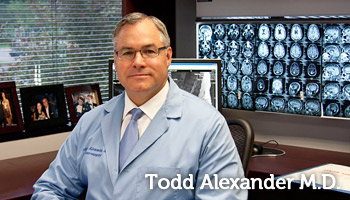
Who is Dr. Alexander, Neurosurgeon in Rockford, IL?
Where did Dr. Alexander go to medical school and complete their residency?
Medical School: Washington University School of Medicine, St. Louis
Is Dr. Alexander board certified as a Neurosurgeon?
Yes, Dr. Todd Alexander, MD is board certified by the American Board of Neurological Surgery
What languages does Dr. Alexander speak?
Dr. Alexander and their clinical team can communicate with patients in the following languages:
- English
What conditions does a Neurosurgeon like Dr. Alexander typically treat?
As a Neurosurgeon, Dr. Alexander diagnoses, treats, and manages a wide range of conditions. This condition information is derived from anonymized insurance claims and highlights the medical conditions most commonly treated by Dr. Alexander. It provides insight into the doctor’s areas of experience and expertise based on real-world patient encounters from the past two years, updated quarterly. Learn more about our claims-based healthcare methodology.
Also known as:
- Joint Fusion Status
- Surgical Joint Fusion
- Arthrodesis History
- Fused Joint
ICD-10 Codes:
- Z981: Arthrodesis status
Also known as:
- Traumatic Brain Injury
- Subdural Hematoma
- Head Injury
- Brain Bleed
- TBI
- Subarachnoid Hemorrhage
ICD-10 Codes:
- S065X0A: Traumatic subdural hemorrhage without loss of consciousness, initial encounter
- S066X0A: Traumatic subarachnoid hemorrhage without loss of consciousness, initial encounter
Also known as:
- Lower Back Spinal Stenosis
- Spinal Stenosis
- Narrowing of Lower Back Spinal Canal
- Lumbar Spinal Canal Narrowing
- Lumbar Stenosis
ICD-10 Codes:
- M48061: Spinal stenosis, lumbar region without neurogenic claudication
Also known as:
- Nervous System Surgery Aftercare
- After Surgery
- Post-neurological surgery care
- Brain surgery aftercare
- Spine surgery aftercare
ICD-10 Codes:
- Z48811: Encounter for surgical aftercare following surgery on the nervous system
Also known as:
- Brain Growth of Unknown Type
- Brain Disease
- Brain tumor of unknown nature
- Brain lesion of unknown behavior
- Indeterminate brain mass
ICD-10 Codes:
- D496: Neoplasm of unspecified behavior of brain
What procedures does a Neurosurgeon like Dr. Alexander typically perform?
As a Neurosurgeon, Dr. Alexander performs a variety of medical procedures. This procedure information is derived from anonymized insurance claims and highlights the medical procedures most commonly performed by Dr. Alexander. It provides insight into the doctor’s areas of experience and expertise based on real-world patient encounters from the past two years, updated quarterly. Learn more about our claims-based healthcare methodology.
Also known as:
- Neck Spinal Fusion (Cervical)
- Spinal Cage Insertion for Fusion
- Lumbar Spinal Fusion (Posterior Interbody)
- Neck Spinal Fusion
- Cervical interbody fusion
- Anterior cervical discectomy and fusion (ACDF)
- Neck vertebrae fusion
- Interbody Device Implantation
- Spinal Fusion with Cage
- Synthetic Disc Space Device
- PLIF Surgery
- Posterior Lumbar Interbody Fusion
- Spine Fusion with Laminectomy
- Lumbar Back Fusion
- Cervical Interbody Fusion
- Anterior Cervical Fusion
- Spinal Cord Decompression Surgery
CPT Codes:
- 22551: Arthrodesis, anterior interbody, including disc space preparation, discectomy, osteophytectomy and decompression of spinal cord and/or nerve roots; cervical below C2
- 22853: Insertion of interbody biomechanical device(s) (eg, synthetic cage, mesh) with integral anterior instrumentation for device anchoring (eg, screws, flanges), when performed, to intervertebral disc space in conjunction with interbody arthrodesis, each interspace (List separately in addition to code for primary procedure)
- 22630: Arthrodesis, posterior interbody technique, including laminectomy and/or discectomy to prepare interspace (other than for decompression), single interspace, lumbar;
- 22552: Arthrodesis, Anterior Interbody, Including Disc Space Preparation, Discectomy, Osteophytectomy And Decompression Of Spinal Cord And/Or Nerve Roots; Cervical Below C2, Each Additional Interspace (List Separately In Addition To Code For Primary Procedure)
Also known as:
- Donor Bone Graft for Spine Surgery
- Lumbar Disc Herniation Surgery
- Spinal Allograft
- Structural Bone Graft (Spine)
- Donor Bone for Spine Fusion
- Lumbar Laminotomy
- Herniated Disc Decompression (Lower Back)
- Microdiscectomy (Lumbar)
CPT Codes:
- 20931: Allograft, structural, for spine surgery only (List separately in addition to code for primary procedure)
- 63030: Laminotomy (hemilaminectomy), with decompression of nerve root(s), including partial facetectomy, foraminotomy and/or excision of herniated intervertebral disc; 1 interspace, lumbar
Also known as:
- Spinal Instrumentation Placement
- Spine Stabilization Hardware
- Posterior Spinal Fixation
- Harrington Rod Placement
- Pedicle Screw Fixation
CPT Codes:
- 22840: Posterior non-segmental instrumentation (eg, Harrington rod technique, pedicle fixation across 1 interspace, atlantoaxial transarticular screw fixation, sublaminar wiring at C1, facet screw fixation) (List separately in addition to code for primary procedure)
Also known as:
- Spinal Instrumentation (Anterior)
- Anterior Spinal Fixation
- Spine Stabilization Surgery
- Vertebral Segment Instrumentation
- Spinal Fusion Hardware
CPT Codes:
- 22845: Anterior instrumentation; 2 to 3 vertebral segments (List separately in addition to code for primary procedure)
Also known as:
- Local Bone Graft for Spine Surgery
- Spine Autograft
- Local Bone Harvest for Spine
- Spinal Fusion Bone Graft
CPT Codes:
- 20936: Autograft for spine surgery only (includes harvesting the graft); local (eg, ribs, spinous process, or laminar fragments) obtained from same incision (List separately in addition to code for primary procedure)
Also known as:
- Brain Blood Clot Drainage (Burr Hole)
- Burr hole surgery for hematoma
- Extradural hematoma drainage
- Subdural hematoma evacuation
- Brain bleed drainage
CPT Codes:
- 61154: Burr Hole(S) With Evacuation And/Or Drainage Of Hematoma, Extradural Or Subdural
Also known as:
- Lumbar Spinal Decompression with Fusion
- Lumbar Laminectomy for Spinal Cord Decompression
- Laminectomy with Fusion
- Facetectomy with Spinal Fusion
- Foraminotomy with Interbody Arthrodesis
- Spinal stenosis surgery
- Lumbar decompression surgery
- Laminectomy for nerve pressure
- Spinal cord decompression
CPT Codes:
- 63052: Laminectomy, facetectomy, or foraminotomy (unilateral or bilateral with decompression of spinal cord, cauda equina and/or nerve root[s] [eg, spinal or lateral recess stenosis]), during posterior interbody arthrodesis, lumbar; single vertebral segment (List separately in addition to code for primary procedure)
- 63005: Laminectomy with exploration and/or decompression of spinal cord and/or cauda equina, without facetectomy, foraminotomy or discectomy (eg, spinal stenosis), 1 or 2 vertebral segments; lumbar, except for spondylolisthesis
Also known as:
- Computer-Assisted Brain Surgery (Stereotactic)
- Stereotactic Neurosurgery
- Image-Guided Brain Surgery
- Cranial Navigational Procedure
CPT Codes:
- 61781: Stereotactic computer-assisted (navigational) procedure; cranial, intradural (List separately in addition to code for primary procedure)
Does Dr. Alexander accept my insurance?
Please contact Dr. Alexander's office to confirm accepted insurance plans.
Where is Dr. Alexander's office located?
What hospitals are Dr. Alexander affiliated with?

Castle Connolly Top Hospital
This doctor is affiliated with a Castle Connolly Top Hospital.
Dr. Alexander has admitting privileges at the following hospitals:



What is Dr. Alexander's NPI number?A National Provider Identifier (NPI) is a unique ID number that identifies doctors and healthcare providers nationwide.
Dr. Alexander's National Provider Identifier (NPI) number is 1972572139.
What common questions do patients ask about Dr. Alexander?
Here are answers to patients Frequently Asked Questions (FAQ’s) about Dr. Alexander